
Franklin County Parole and Probation Compared
Missouri uses several forms of community supervision, and the label matters. A Franklin County court may order probation as the sentence or as part of a suspended sentence. The Missouri Parole Board may grant parole after part of a state-prison sentence has been served. Conditional release is a statutory supervised portion of some prison terms. None of these labels alone supplies the time that a person walked out of the Franklin County Adult Detention Facility.
| Status | Who authorizes it | What it establishes |
|---|---|---|
| Probation | Sentencing court | Community supervision under a court sentence; it does not prove a Missouri prison release. |
| Parole | Missouri Parole Board | Discretionary release from prison while the person remains in DOC legal custody. |
| Conditional release | Missouri law and DOC calculation | The supervised part of an eligible prison sentence, not final discharge. |
| Final discharge | Court, Board, or DOC process as applicable | Supervision has ended; the active-only public search may then stop returning the person. |
A transfer from the county jail to a DOC institution is not parole. Likewise, a court order placing a person on probation does not by itself prove the exact county-jail exit time. The Franklin County released-inmate search guide explains how to pair the court event with the jail custody entry.
Verify Franklin County Post-Release Supervision
The official first step is the Missouri DOC Offender Web Search. It covers active offenders, including people in prison and people on probation, parole, conditional release, or another active DOC status. Search results must be read according to the live labels. An institution such as Missouri Eastern Correctional Center means confinement continues. A field or community assignment supports release from prison into supervision.
- Search by DOC ID when it is known. Otherwise, enter the exact first and last name and test legitimate spelling variants.
- Match the DOC number, full name, photograph if displayed, sentence information, and lawful identifying details. Do not rely on a common name alone.
- Read the assigned place and institution or field indicator. Record the status exactly instead of replacing it with a broader word such as “released.”
- Use the Division of Probation and Parole directory to identify the office shown for the active case.
- Contact the office for purpose-neutral confirmation of active supervision and office assignment, subject to access limits.
- If no result appears, check the sentencing case and request a DOC historical or discharge record. The public search is not a complete archive.
A missing active record has several possible explanations: a name mismatch, no Missouri DOC history, a data limitation, or completed discharge. It cannot be dated by assumption. DOC’s prior-offender data and records route, along with the sentencing court record, provide the stronger historical trail.
Franklin County Supervision at District 16
The local office is Missouri Probation and Parole District 16 in Union. Its assignment can confirm a local field-supervision connection after a state-prison release. It does not establish that someone left the Franklin County jail, and it does not show that supervision has ended. The office serves more than Franklin County, so an office match must still be tied to the correct person and DOC record.
District 16–Union
#3 Truman Court
Union, MO 63084
(636) 583-8933
Serves Franklin, Warren, Montgomery, and Gasconade counties.
Missouri Parole Board
(573) 751-8488
DOC.MissouriParoleBoard@doc.mo.gov
Board decisions and parole authority are distinct from field-office supervision.
The official District 16 page is the source for the four-county service area. Confirming the office narrows the supervision question, but a county custody record remains necessary when the question is about the physical release from Detention/Booking.
Office assignment also must be read in time. A current District 16 assignment supports present local supervision. An old order naming that office may have been followed by transfer, revocation, expiration, or discharge. When the date matters, compare the active DOC record with the latest court or Board action and ask the office to confirm only the current public status it can provide. Do not publish a field officer’s private contact details or infer where a supervised person is located from the district address.
The official District 16 page provides a useful visual reference for the local supervision office.
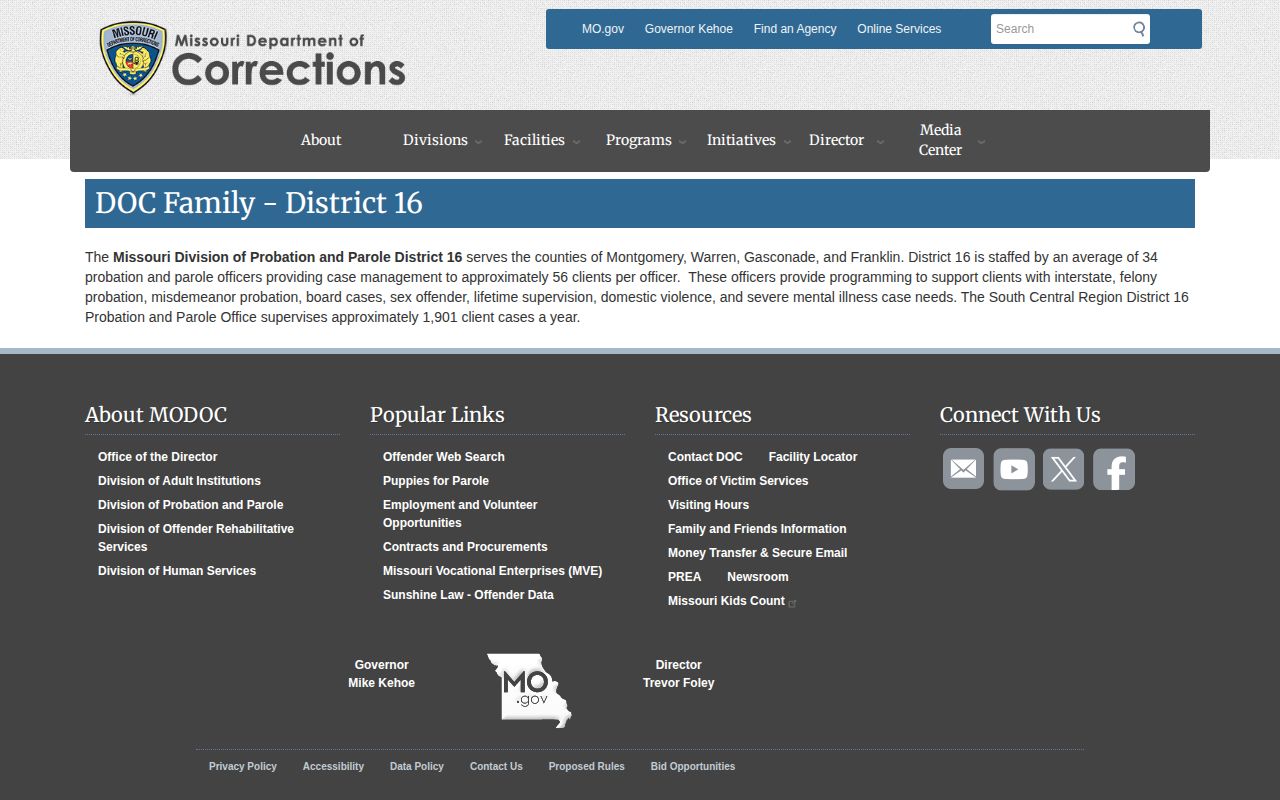
The office page should be matched to the person’s active DOC assignment, not treated as a public roster of everyone supervised in Franklin County.
Franklin County Supervision Conditions and Violations
Conditions come from the court, Parole Board, and supervising authority. The individual order and DOC record control. A violation can lead to added reporting requirements, a hearing, a warrant, suspension of credits, or revocation proceedings, but the research does not support predicting one outcome from a bare status label.
No official public Franklin County or statewide name-based list of all probation or parole absconders was found. DOC’s Command Center works with law enforcement, yet that operational role is not a public lookup. The Missouri Sex Offender Registry has a specific absconder function for qualifying registrants only. It must not be generalized to people outside that registry.
For a court-probation question, read the Franklin County case chronology for probation orders, violation filings, warrants, revocation, and discharge. For parole or conditional release, rely on DOC and Board records. MOVANS may provide eligible event notices, but a notice is not a substitute for the order or agency record that created the event.
Franklin County Supervision and Earned Compliance
Missouri earned compliance credit affects eligible community supervision. It is not prison good time and should not be used to calculate the date someone leaves a jail or prison. Under Missouri law, an eligible compliant person on probation, parole, or conditional release can receive thirty days of credit for a full compliant calendar month. Credits are not earned during specified violation, custody, revocation-motion, suspension, or absconder periods.
The DOC early-discharge guidance explains that Probation and Parole calculates the remaining term, while legal authority for discharge depends on the case. A sentencing court can reduce probation. The Parole Board acts on parole and conditional release. Credit can help satisfy the term, but it does not turn an estimated date into an official discharge order.
Note: A person may remain visible in the active DOC search after leaving prison because community supervision continues under Missouri DOC authority.
Proving Franklin County Supervision Discharge
Final discharge and physical release are different milestones. Someone released from Missouri Eastern Correctional Center on parole may appear under field supervision for years. When parole or conditional release ends, the person can disappear from the active-offender search because that interface covers active cases. The absence of a result does not provide a discharge date.
For a durable record, request the DOC discharge material or consult DOC’s Sunshine and prior-offender data. The downloadable data can include a completed flag, sentence dates, assigned place, institution or field status, and minimum and maximum release dates. A completed flag supports sentence completion, but it is not necessarily the physical prison-gate time. The court or Board order may also be needed to explain the legal basis.
A presumptive parole date deserves the same restraint. It is tentative and can depend on conduct and an acceptable release plan. A Board decision may authorize or anticipate release, while the later DOC status shows whether institutional custody actually changed. If the question concerns a person released from MECC, use both records rather than treating the scheduled date as the completed event.
For probation ordered in Franklin County, review the case docket for a discharge entry and obtain the order from the Circuit Clerk when a certified record is needed. For parole, use the Board and DOC channels. Keep the jail release timestamp separate: the Franklin County Adult Detention Facility record answers when county custody ended, while the supervision record answers what followed and when it concluded.
The Franklin County Circuit Clerk provides the local court-record route, while the Sheriff’s official page identifies the county records channels. Use each office for the record it maintains.
Property After a Franklin County Jail Release
Franklin County publishes a practical detail on its official detention page that is separate from parole status but important at the custody transition. Commissary purchases leave with the person. Remaining account funds are issued on a debit card when possible. If release or transfer prevents that process, the former detainee has an official pickup or mail route.
The detention facility states that a former detainee may return Monday through Friday from 8:00 a.m. to 4:00 p.m. Otherwise, the person may mail a notarized request with a stamped, addressed envelope to the Commissary Deputy at #2 Justice Lane in Union. Unclaimed balances move to Missouri unclaimed property after the county’s end-of-October process.
These property details do not prove probation, parole, or release reason. They show what happens to funds and purchases when county custody ends. A transfer can trigger the same property process even though confinement continues with DOC or another custodian, so the destination must still be confirmed.